What My Yoga Training Has Brought Me, So Far
I’ve only been at this a few weeks, with only two weeks of 3-5 hours of daily practice that accompany the intensive studying. But to say that my yoga training so far has been transformational would be an understatement. My decision to undertake these studies with my good friend and teacher Nikki Costello has been a giant gift and a great enhancement to my health and spiritual practices. My later-life health and longevity toolbox is growing by the day. Here are a few highlights of my in-progress training to become a certified yoga instructor. (I will write more about all this in the future.)
Iyengar Yoga: Intensity and Effort, Yet Forgiving and Accommodating
The asana (pose or posture) training is arduous, demanding, and rigorous. Yet once I “get” a pose, it becomes decidedly easier and more relaxed, enabling me to hold it, breathe, and adjust the parts of my body that need subtle lengthening and expansion (space) in order to hold the pose longer and better. Before this training, I had a limited roster of poses I was familiar with. I am now in the process of learning close to 100 of them (I’m better at some than others), and I’m learning the benefits of each pose to the joints, inner organs, muscles, posture, and a lot more. I have managed to keep up a limited amount of Zone 2 exercises and High Intensity Interval Training (HIIT) work, but the days are full, and I am tired by the end of day in a way that I’m not sure I’ve ever been before.
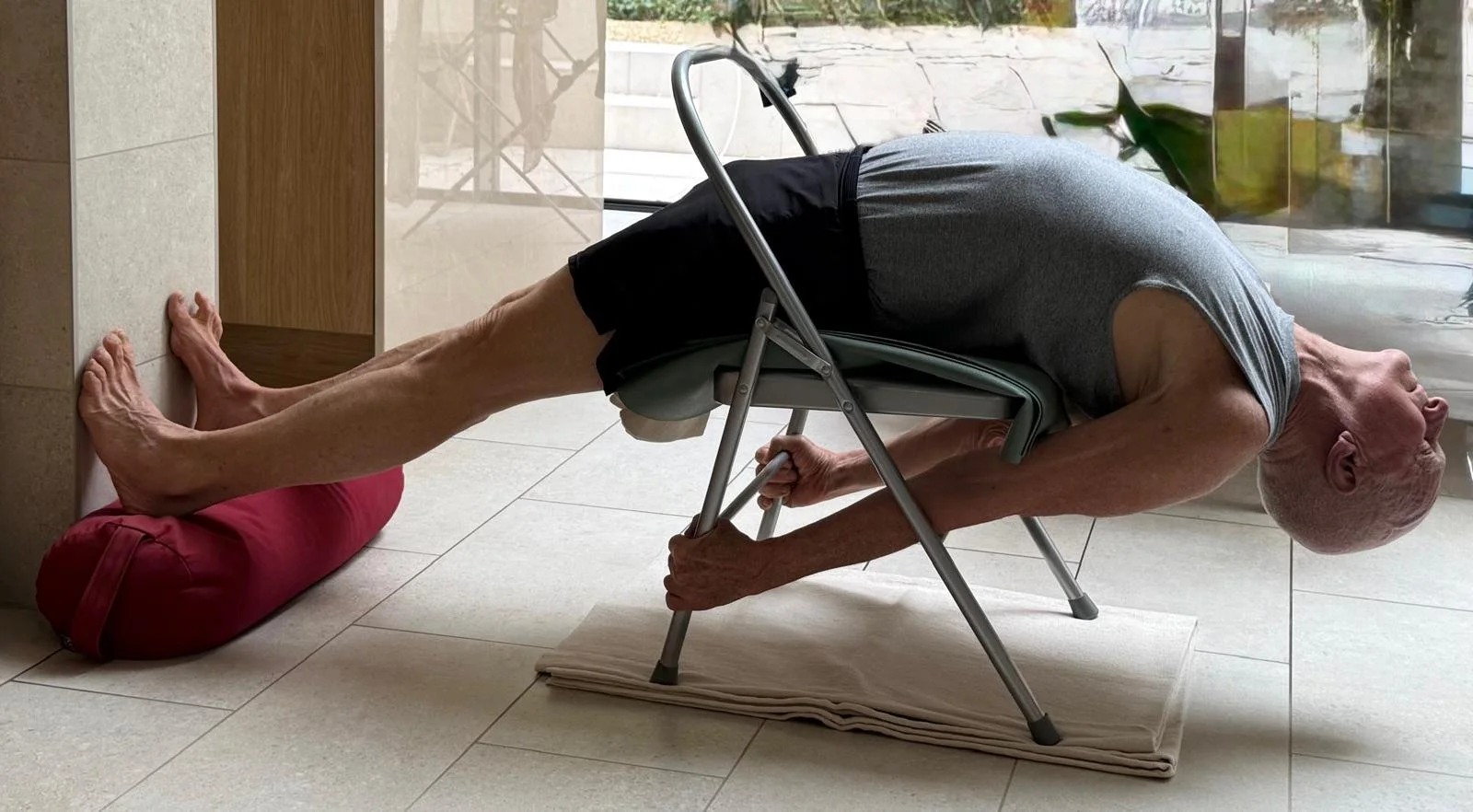
I’ve discovered that restorative poses play a big role in Iyengar yoga, the form of yoga that I am primarily learning. Restorative poses focus on deeply relaxing the body and calming the mind. Iyengar yoga also makes use of lots of props, such as chairs, belts, blocks, blankets, and bolsters—all of which are used to learn postures as well as support parts of my body that aren’t as flexible as they used to be or simply aren’t accustomed to being used at all. Plus, Nikki has customized my yoga training, with a focus on my individual needs and my personal interests, both in what I’m doing and how I will teach others, with an emphasis on health, longevity, and staying mobile as we get older.
Restorative postures and practices are far different and held much longer than a casual cool-down stretch after a run or bicycle ride or stretching at the gym, or even the 3-5 minutes of rest, called savasana, at the end of most yoga classes. The ones I’m doing, often 15 – 30 minutes and in different positions, are deeply restful as well as intensely spiritual. (Think inner peace on a very deep and undistracted level.) The practice of pranayama, which incorporates many different breathing methods, is particularly effective on this front.
However, the restorative aspects along with the intensive effort are intended to be combined and not practiced separately. In other words, you can’t just skip to the restful parts without having first done the hard parts. This is an aspect of the yin and yang of what makes yoga such an ancient and venerated artform, art of the body that is.
First and Foremost a Whole-Body Health Practice
What I’m learning is first and foremost a health practice for body, mind, and soul as well as the entire inner body of organs, immune system, respiration, and circulation. Yoga in its fullest expression has always been deeply concerned with all aspects of health, not just a good physical workout. Most people associate it with flexibility, balance, and strength, whether the focus is on the legs, hips, arms, shoulders, knees, or neck. But the health of all of the organs, the mind, and the ultimate meaning of life are all part of the yoga practice I’m learning. How much of it sticks, makes its impression, and dovetails with my existing health ideas and practices remains to be seen. But for now, I am immersing myself in my yoga training as fully as possible to see what it has to teach me.
Effects on Posture and Breathing and the Sensation of More Space
One aspect that has already caused me to notice and change is my posture. The poses I am doing enhance awareness of how I sit, stand, and move, not only when I practice but also throughout the day. The poses also enhance breathing and allow my lungs to expand sideways as well as the normal up and down motion of the breath. This sensation of being in good posture has already made a deep impression on me, and I practice holding a strong posture as I move around. I have also made subtle adjustments in how I do my gym work because of this new awareness in both posture and breathing, which has improved the quality and concentration of my gym workouts.
These changes have led to a greater sense of space inside me. This includes more room to breathe, more room in my joints, and even more room in my heart and mind. Some of this is very subtle, but the association I have developed with the physical space inside me and the emotional space I feel as I move through the day is palpable. The pressures of life seem somehow less urgent when I sense this internal space, and the link to physical space that has been created by opening up parts of my body in yoga poses definitely seems to be linked in some fundamental way. This awareness around posture, breathing, and space has been transformational—an unexpected gift so early in my yoga training.
More soon…